Quick answer (TL;DR)
Buy a conventional single-family house near Dahlonega if you want easy financing, predictable maintenance, and full-time living. Buy a cabin if you want woods, acreage, character, and a weekend escape, and you accept log upkeep, well and septic, private roads, and financing that can take more shopping. Rental income is possible with either but is never guaranteed; verify county and HOA rental rules in writing before you count on a dollar of it.
The house-versus-cabin question is the first fork most Dahlonega buyers hit. This comparison covers price, financing, maintenance, daily life, and the rental questions to settle before choosing between a subdivision house and a mountain cabin.
Every week someone calls about a Dahlonega house for sale, falls in love with a log cabin on acreage the same afternoon, and ends the day confused. Both can be the right answer. They are different products with different costs of ownership, and the fastest way to choose honestly is to walk the trade-offs side by side, which is what this guide does.
House vs cabin in Dahlonega: the honest trade-off
About the figures in this article: cost and maintenance figures are typical ranges at publication, not quotes. Verify current prices with your MLS source, lenders, and local contractors before relying on any number.
A subdivision house is an appliance: familiar, financeable, and boring in the good way. A cabin is a commitment: character and solitude paid for in stain, gravel, and pump repairs. Neither is better. They solve for different buyers.
What each type costs to buy
Single-family houses in the Dahlonega area have historically started around $300K for a basic three-bedroom in a subdivision and run to the high $600Ks and beyond for newer construction with modern finishes on a larger lot. You get conventional stick-built or modular construction, standard utilities in many subdivisions, and floor plans lenders and appraisers see every day.
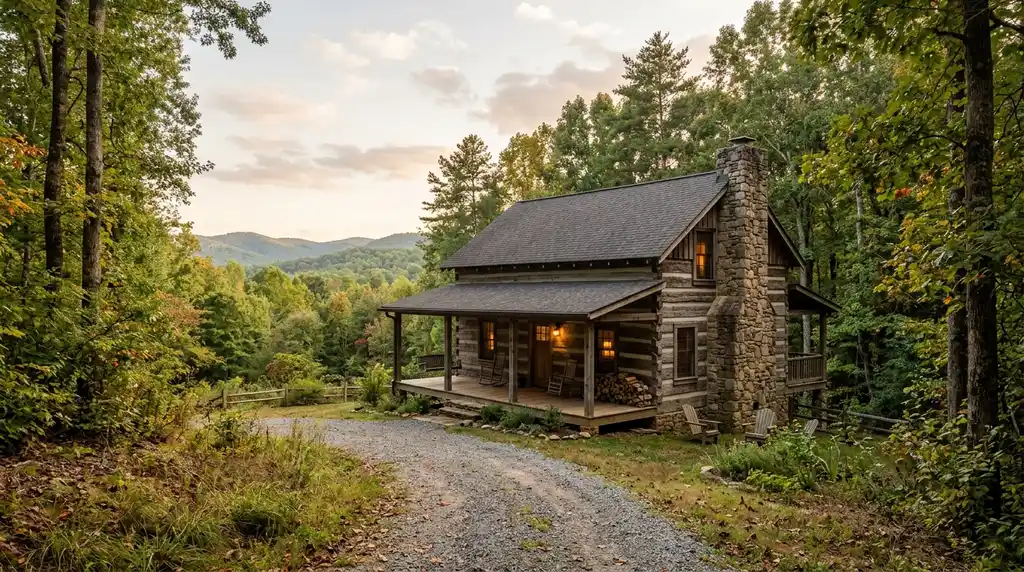
Cabins in Lumpkin County have historically ranged from the low $200Ks for older, smaller structures on modest lots to the $600Ks and up for large modernized log homes with views or river access. The setting is the product: wooded acreage, natural materials like log, timber frame, and board-and-batten, and almost always a private well and septic system.
Financing a house versus financing a cabin
Houses finance the standard way: conventional, FHA, VA, and USDA rural loans all apply when the property qualifies, and appraisals are routine where comparable sales exist. Well-qualified buyers commonly find low-single-digit down payment programs.
Cabins take more shopping. Lenders weigh the age and condition of the structure, log construction specifically, how the property will be used, and the utility situation. Vacation-home and investment loans typically carry larger down payments than primary-residence loans, and older cabins in rough shape can push you toward portfolio financing. A lender who already works the North Georgia mountains will tell you in days what a generic lender discovers in weeks.
Maintenance: the difference buyers underestimate
A house carries the usual residential load: HVAC servicing, a roof cycle, gutters, lawn care, and in the mountains, chimney attention and occasional private-drive grading. Predictable, and easy to budget.
A cabin carries all of that plus a second list. Plan for exterior refinishing, sealing, and restaining — typically $3,000-$8,000 every 3-5 years depending on exposure and finish — along with chinking checks and moisture watch, because neglected log exteriors get expensive fast. Wells and septic need annual attention, and replacement, when it comes, is a real line item: well pump replacement is commonly quoted in the $800 to $2,500 range and septic system replacement far higher, so get actual local numbers during due diligence. Steep unpaved drives want gravel and grading after hard rain and ice. Mountain properties also carry more pest pressure from termites, carpenter ants, and wood-boring beetles, which annual inspections catch early.
The day-to-day life of each
House life is the low-friction version of mountain living: neighborhoods, paved access, a short drive to the square, and routines that fit school-age kids and full-time work. Cabin life is the reason people move here in the first place: isolation near the Chattahoochee National Forest, wildlife through the window, weather you can watch arrive, and a fireplace-winter feeling no subdivision replicates. It trades convenience for that on purpose.
Rental use: verify before you count on it
Weekend visitors often prefer a cabin in the woods to a house in a subdivision, which is why cabins carry the stronger short-term rental appeal in this market. Appeal is not income, and no honest agent will quote you a guarantee. What you can do before buying is verify the three things that decide whether renting is even allowed: the Lumpkin County or City of Dahlonega rules for the parcel, the HOA or subdivision restrictions in writing, and whether the well and septic system can handle guest-level occupancy. Verify the HOA’s short-term rental rules in writing before purchase.
How to decide between them
Choose the house if you want conventional financing, manageable maintenance, and a permanent residence in a mountain town, or read more about how this site covers the market first. Choose the cabin if you want character, acreage, privacy, and the authentic experience, priced honestly as a commitment of money and weekends. If rental income matters to the math, settle the rules question before the emotional one, and bring anything the comparison does not answer to the contact page. More deep-dives land on the blog as they are written, and your fair housing rights apply through the whole search.
Frequently Asked Questions
Is it cheaper to buy a house or a cabin in Dahlonega?
Entry prices have historically been lower for small older cabins, but the purchase price is only the entry point. Cabin ownership adds log maintenance, well and septic care, and private-road costs that a subdivision house mostly avoids. Compare total cost of ownership, not list price.
Are log cabins hard to finance?
Harder, not impossible. Age, condition, log construction, and intended use all shape the offer, and vacation or investment use means larger down payments than a primary residence. Some older cabins end up in portfolio loans. A lender experienced with North Georgia mountain properties is the shortcut.
How much maintenance does a log cabin need?
Budget for exterior refinishing, sealing, and restaining — typically $3,000-$8,000 every 3-5 years depending on exposure and finish — plus chinking checks, annual pest inspection, chimney sweeping, and the usual well and septic attention. Deferred log maintenance is the expensive kind, so keep the schedule.
Can I rent out a house or cabin on Airbnb in Lumpkin County?
Sometimes, and the rules are property-specific. Lumpkin County and the City of Dahlonega handle short-term rentals differently, and HOA or subdivision restrictions can prohibit rentals outright. Get the answer in writing for the specific parcel before you buy, and confirm the septic system supports the occupancy you plan.
Which holds its value better, a house or a cabin?
Houses appraise against abundant comparable sales, which steadies value. Cabins are more idiosyncratic: a special property with a view or frontage can command a premium, while a worn cabin with deferred maintenance corrects hard. Condition and setting drive cabin value more than the market average does.
Is a cabin a good first home?
Usually not, unless you already know your way around a pressure tank and a chainsaw. First-time buyers generally do better with the predictable systems of a conventional house while they learn the area. The cabin makes a strong second purchase once the habits are in place.
What is winter like at a Dahlonega cabin?
Quiet and occasionally serious. Elevation means cooler summers but snowier, icier winters, and unpaved switchback drives can become an event. Ask about road maintenance responsibility and year-round access before you offer, and decide whether you will love the snow or merely tolerate it.
Do cabins and houses differ on insurance?
They can. Wood-heavy construction, wood stoves, private roads, and distance from fire service all shape premiums for cabins, and river-adjacent parcels add the flood-zone question. Get real quotes on the specific property during due diligence instead of assuming either type is cheap to insure.
Should I build a cabin instead of buying one?
Building buys you exactly what you want and costs you time, construction loans, and the surprise line items that mountain lots produce: driveways, power runs, well placement, and septic suitability. Buying existing lets you see the finished product and its maintenance history. Both paths work; go in with eyes open on either, and ask any builder for references from their last two finished mountain builds rather than a portfolio.
Can I use a Dahlonega property as a vacation home and rent it part-year?
That hybrid use is common, and it is exactly the case where the rules matter most. Lender terms, county rules, HOA restrictions, and tax treatment can all shift with usage, so line up the answers in writing before the purchase rather than after. The plan is fine when the paperwork agrees with it.
Both paths are easier with someone who has walked them. Discover Dahlonega, Georgia properties with Gold Peach Realty or call (770) 283-1223.